
Bắc
Hà NộiCrisp consonants, all six tones held apart. The reference accent, and the easiest place to begin.
Train with audio Vietnamese people actually listen to. Write down what you hear, then see exactly which syllable — and which tone — slipped past you.
No card required · Learn in English, practise in Vietnamese

“Bạn có biết không?”
Heard biếc · hông · southern voice
Close — listen once more ↗
Across WELE, all languages · this month
2,280+
listening hours
42,159+
listening sessions
1,168+
active learners
5,398+
submissions
The listening gap
It is rarely a vocabulary problem. Your ear has not yet learned what written Vietnamese does to itself once it becomes real speech.
The same letters carry six different meanings. A tone is not something you can infer from context — you either caught the pitch or you did not.
Final consonants soften, merge or drop entirely in everyday speech, so words you know on paper arrive at your ear in an unfamiliar shape.
Hanoi, Huế and Saigon each treat the tones differently. Learn one and the others can sound like a language you have never studied.
You can have the vocabulary, the grammar and the flashcard streak, and still lose the sentence the moment somebody speaks at natural speed.
Inside a lesson
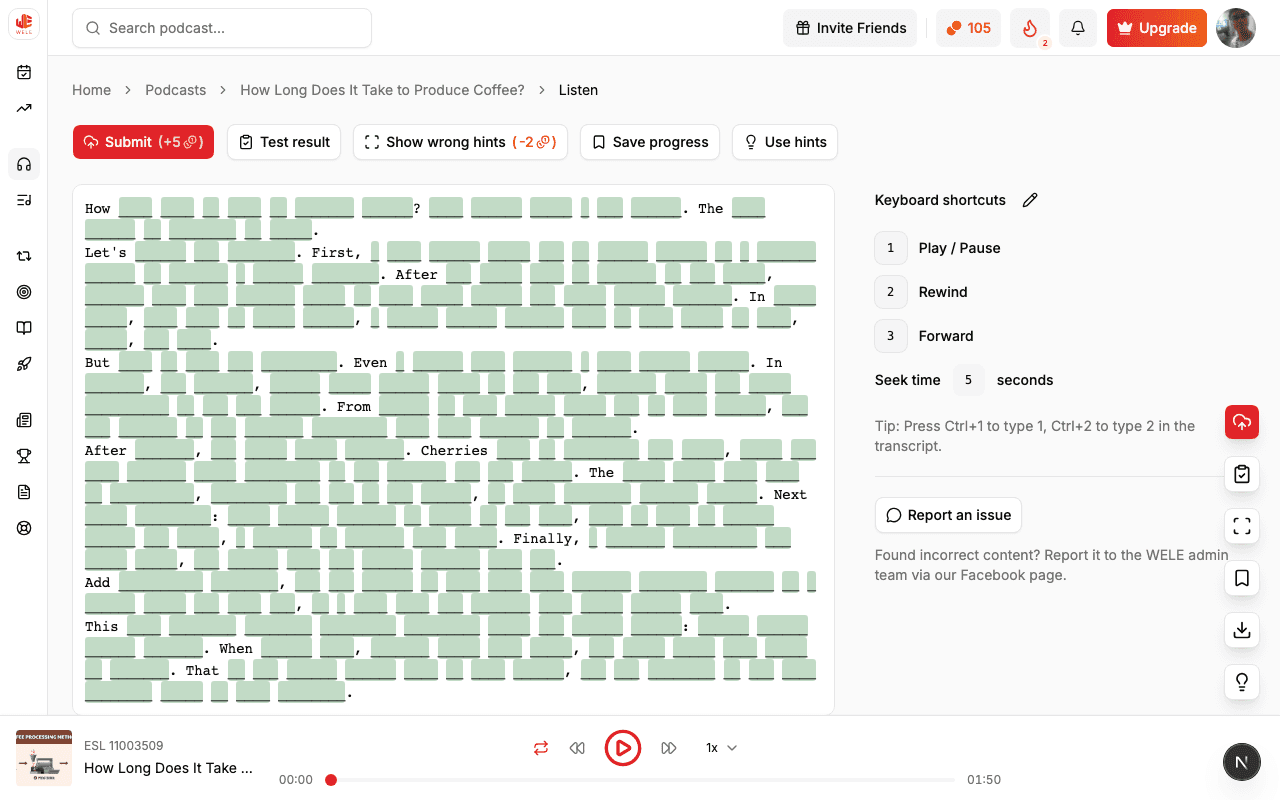
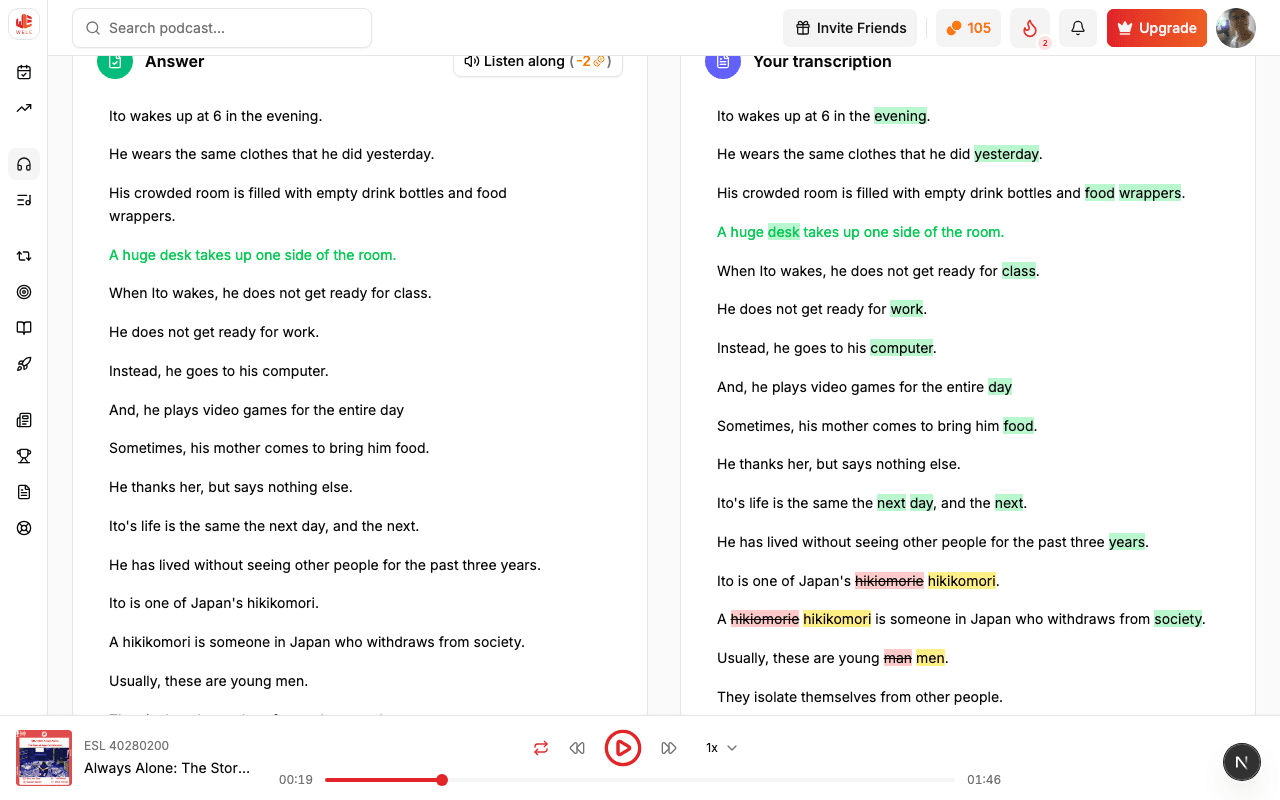
WELE keeps the workspace quiet so your attention stays on the sound. Work sentence by sentence, then set your transcription beside the original.
The WELE method
Dictation turns passive listening into deliberate practice: you commit to a prediction, receive precise feedback, then listen again knowing what to listen for.
Take in the whole thought before you start hunting individual words.
Transcribe the sentence exactly as your ear received it — tone marks and all.
Reveal the transcript and look at every difference, however small.
Difficult words come back later, timed to the moment you were about to lose them.
Anatomy of sound
Six tones sit on the page as small marks above a vowel. In the air they are movement — rising, dipping, breaking, dropping. A transcript lets you stop the moment and hear which one actually went past.
One syllable. Six words. Nothing on the page tells your ear which one just arrived — only the pitch does.
Field notes · spoken Vietnamese
What the page says / what the ear receives
The listening shelf
Not studio-recorded textbook audio. News, radio, interviews and essays — sorted so you can start where the speech is clearest and move toward where it is fastest.
One language, three voices
Crisp consonants, all six tones held apart. The reference accent, and the easiest place to begin.
Softer consonants, drawn-out vowels, a melody of its own. The one that rewards patience.
Hỏi and ngã collapse together, finals soften, the pace relaxes. The voice of the south.
Where the audio comes from
Daily bulletins from the public broadcaster. Studio diction, current vocabulary, predictable structure.
Traffic radio: unscripted, quick, full of the contractions a textbook will never show you.
Business, design and city life, spoken the way young Vietnamese actually talk.
Unhurried conversation. The right shelf once single sentences have stopped frightening you.
Prepared, well-paced speech carrying an argument worth transcribing twice.
Community essays narrated in full: opinion, analysis and a denser vocabulary than the news.
Built for deliberate practice
No noisy lesson map, no endless rewards loop. Tools to practise, notice what you missed, and come back to it.
A language becomes yours when a voice stops sounding foreign.
About us
We build listening practice around real voices and feedback you can act on. Vietnamese gets its own treatment here — six tones, three regions, and endings that vanish — but the WELE principle is unchanged: practise actively, understand your mistakes, and make progress you can feel.
Simple pricing
The core experience is free. Premium adds depth without turning your learning into a subscription puzzle.
Learner notes
Thuy
Heritage learner · San Jose
Adam
Living in Vietnam · Ho Chi Minh City
Priya
Learning with her partner · Melbourne
Before you begin
Still wondering whether dictation suits your level, your accent or your schedule? Start here.
Begin with one short passage. The next time that tone goes past, it may not go past unnoticed.
Start learning free